
Soon after I discovered Waldorf education, I had a conversation with a friend whose daughter, like my son, was approaching kindergarten age. We lived in Los Angeles, where getting one’s child into the “right” kindergarten had as much significance as getting accepted to Harvard or Yale.
“Have you considered the Waldorf school?” I asked her.
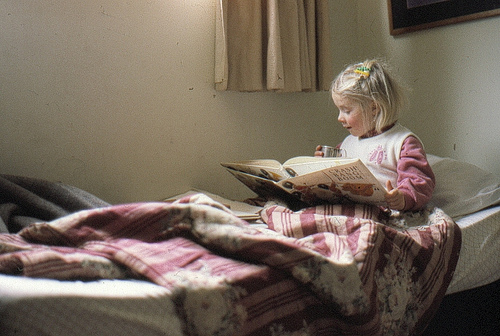
“Oh, we looked at it, but ruled it out because they don’t believe in books. We are a family of readers,” she emphasized.
I was taken aback. Did my friend think that my husband I, both college graduates, didn’t value books or reading?
I knew that reading wasn’t formally taught in a Waldorf kindergarten, and I’d heard that children created their own textbooks, but in all my research, I’d never heard that Waldorf schools were anti-books. I would soon learn that this was one of many common misconceptions about Waldorf education.
In the coming years, I not only enrolled my son in the Waldorf school, but I also enrolled myself in Waldorf teacher training and came to a deeper understanding of how reading is taught. I hope that the insights I’ve gained will help some of you who may be considering Waldorf education.
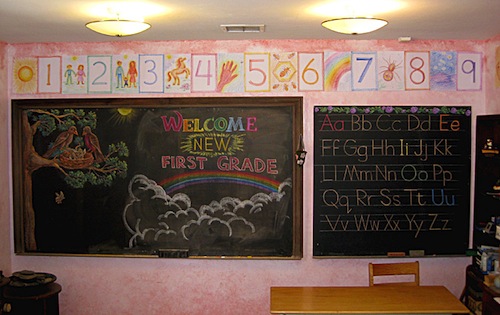
Blackboard Drawing by Allen Stovall
The Evolution of Language
In the evolution of humanity, spoken language developed first. Then came written language, originally through symbols (think hieroglyphics). Finally, once there was a written language, people learned to read.
This is exactly the sequence in which children master language, and so is the sequence in which reading is taught in Waldorf education. From birth to age seven, the focus is on the spoken word.
The children hear stories – nursery rhymes, nature stories, folktales and fairy tales. Teachers are careful to use the original language of fairy tales without “dumbing them down” or simplifying the language. The teacher is careful to use clear speech and to enunciate. This will help children later when it comes time to learn to write and spell.
In early childhood, language is taught through story time and circle time: songs, verses, rhymes and poems are all incorporated. It may look like play, but language skills are being developed daily.
Repetition
Because the same circle time sequence is repeated daily for 2-3 weeks at a time, children learn the songs and verses “by heart,” and will retain them for life.
Rudolf Steiner, founder of Waldorf education, stressed the importance of repetition when he developed the first Waldorf school in Germany in the 1920’s. Current brain research confirms that repetition aids a child’s brain development. The connections of billions of neural pathways in the brain are strengthened through repeated experiences.
Speaking
A visitor to a Waldorf kindergarten might notice the children are not being taught the ABC’s. They are not given worksheets, nor do they practice reading from books. But we Waldorf teachers know that language skills are being built through the repetition of stories, songs and verses. We are preparing children to read and write through the spoken word.
On the other hand, that same observer is likely to be impressed by the children’s precocious verbal abilities; their impressive vocabulary, and the number of poems and stories that they can recite by heart.
In addition to our work with speech, we work on building a child’s fine motor skills—through activities such drawing, finger knitting and sewing—to prepare children for the next stage of language development: writing.
Writing
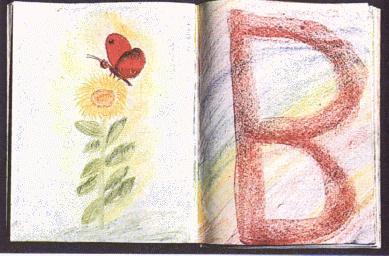
It is during first grade in a Waldorf School when the alphabet is formally introduced, but in an imaginative, pictorial way. Think again of hieroglypics. Each letter of the alphabet is introduced as a symbol, representing an element from a story the children are told. For example, they might hear the story of a knight on a quest who had to cross mountains and a valley. The children will then draw a picture with the letter “M” forming the Mountains on either side of the “V” for Valley.

Blackboard Drawing by Allen Stovall
In this way, the child develops a living relationship with each letter and the written word. It is not dry and abstract. Writing is taught in a way that engages the child’s imagination.
After learning all the letters, the next step is to copy the teacher’s writing. Typically the children will recite a poem together until it is learned by heart.
Then the teacher will write the poem on the board, and the children will copy it into their “main lesson books,” the books that children in a Waldorf school create themselves.
Because the children already know the poem and they have learned the alphabet, they will begin to make connections. “Oh, this must spell “brown bear” because both these words start with “B” and those are the first two words of the poem!”
Reading
The final step is learning to read, which generally starts in second grade and continues into third grade.
It is important to know that reading requires decoding skills that develop in children at varying ages. In Waldorf education we understand that learning to read will unfold naturally in its own time when a child is given the proper support.
Just as a normal, healthy child will learn to walk without our teaching her, and just as a child miraculously learns to speak her native language by the age of three without lessons, worksheets or a dictionary, so will a child naturally learn to read when she has a positive relationship with the spoken and written word.
Books
Yes, it is true that early readers and textbooks are generally not used in Waldorf education. Instead, the children are fed real literature starting in the earliest years.
Once students are fully reading, they turn to original source texts such as classic literature and biographies, and students will read many great books throughout their grade school years.
What they avoid are early readers of the “See Spot run” variety, and dry, lifeless textbooks.
My Children
It can be hard to trust that this system works, especially when your child’s public school peers are reading at 5, 6 or 7. But I offer you the example of my two sons.
My younger son Will taught himself to read in kindergarten; my older son Harper wasn’t fully reading until third grade. Yet, for each of them, once the decoding skill was unlocked, they became voracious and insatiable readers, consuming piles of books for pleasure throughout their childhood. In high school, Harper scored in the 98th percentile for reading on the SAT.
The age at which they learned to read had no bearing on their lifetime love of reading. However, I believe that the way they were educated had everything to do with it.
Thinking again of my old friend, I wish I knew then what I know now, and could have corrected her misguided perception. Perhaps her children, like mine, might have reaped the bounteous fruits of Waldorf education.

Are your children in a Waldorf school? Are you a Waldorf homeschooler? Considering Waldorf education? Is your child reading yet? Are you concerned about late reading? I’d love to hear your thoughts and comments!


105 Comments
I graduated from a Steiner high school 2 years ago and I am so thankful for my parents sending me there, it is the best thing they ever did for me; and while it is more expensive, and a lot of work from parents, teachers and students, it is well worth it. In saying that, however, Steiner does not suit every child.
On the note of the reading, I have read (sorry I don’t have a reference for it!) that forcing children to read can be detrimental to their health. When they are forced to read they have a tendency to hold their breath, which stops the blood flow to their eyes and they can end up having poor vision and needing to wear glasses from an early age.
I must admit I picked up books early on, as did one of my brothers. The other brother took a little longer to latch on to reading, spelling and comprehension, but when he got it, it was all smooth sailing from there.
And to Marie, Waldorf education is nothing like a cult. That is such a misinformed opinion! Anytime you leave a school you leave that community behind. You moved away and that was your choice. If your children are no longer in those classes why would they be invited to the “class parties”???
In high school you receive the maths, science, English, art etc etc practice lessons that you need, and they are carried into the main lessons as well. The education can’t just be done by the teachers, it has to be carried on in the home environment too.
Many of my friends who graduated received high marks on the SAT/STAT test and all got into their chosen fields, including students who had learning disabilities.
Maybe your children weren’t suited to the education, or you were unlucky and didn’t have a class teacher who was as passionate as they needed to be.
On a final note I would just like to say that I once over heard a public school teacher saying to a friend of hers that she wasn’t there to teach the children to think, she was there to teach them to be good workers.
Now I ask you, do you want your children to be little robots doing everything that their government tells them they must, or do you want them to be individuals who can think for themselves and will question if something doesn’t seem right. I know what I would like.
I agree with the class party comment. My boy was in a community center daycare for 5 years going to many parties and playdates for 5 years. Now he attends summer camp with many of the kids and sees them at activities (like Karate) but never gets invited to parties anymore. Also happened with Kindergarten (a constructivist based private school) last year. Waldorf school has been a great fit for him. I guess it depends on kids though: my son has learned a ton of Russian, a bit of Spanish, way way improved drawing, but he was reading above ‘Waldorf’ level first grade already at entry and seems to have lost the sounding out bit now, he shows no interest in reading but can retell stories with amazing details. Math seems OK but probably not on par with where his public school siblings are and both my kids in public and youngest in Waldorf are way way behind the kids in all academic areas compared to the constructivist school (which is one of those academic prep types…lots of gifted kids, mine not so much).
What I found was that my special needs children with ‘borderline IQ’ did better than expected in public school. My eldest son (adopted when he was 8) was able to read despite having been diagnosed as Moderately mental retardation. He would not have done well in Waldorf. Daughter, also adopted at age 8 could not read, learned to read only after great support of the constructivist school (at age 13 can read simple chapter books like Charolette’s Web).
My biokids all did fine in public school. Typical kids, nothing great or struggling about them.
My son in Waldorf school needs a gentle touch but tested spot on average at end of Kindergarten. The kindergarten, constructivist school, insisted he was severely delayed and should repeat kindergarten due solely to academics (not social or emotional or age–in fact he was oldest in that class). They would only let him move on if I got neuropsychological testing done (particularly IQ, dsylexia/pre-reading as too young to diagnose, memory, and ADHD). IQ was 103 (average score is 100), reading was 1.3 (first grade 3rd trimester), no ADHD, memory 183 or very superior range, but working memory was prekindergarten.
Sorry this got really long. The point was if you can afford it most of us would individualize education by each child. Some do great in public school, some in private, some maybe even boarding, and some in Waldorf or Montosseri or Constructivist.
I have to admit I am scared that my son won’t learn to read, he really has no interest and seems to be relying on memory to get by so far. He can retell stories word for word, is praised to me as best in class at this, memorize poems, songs, is a beast at the 2 languages, so very oral learning. BUT, at 7.5 years old he still struggles to sound out cat or dog correctly.
Grace, I’m very glad that you had a positive experience at your school. However, as I stated in my previous entry, every school is entirely teacher dependent. It sounds as though you had an adequate teacher — great for you. My family, however, did not. Out of three children, only 1 had a decent teacher, the other 2 were fired. One of the teachers was fired for being abusive; the other for lacking the band width to teach even the most basic skills. For you to say that my children were not suited for this education is a very typical response (and one we’ve often heard) from Waldorf fundamentalists who fail to see the shortcomings of this form of education. That said, I have to agree with you that there are many lovely things about a Waldorf education which is why we chose it for our children. But the opportunity costs — both financial and academic — far exceed the benefits.For example, after 8 years of “studying” Spanish and Japanese for an average 5 hours a week each, virtually no students have a fundamental grasp of the language. Ask any 8th grade to say “Is this my house,” in Spanish and you will be greeted with a blank stare and a grin. A common saying amongst the kids is, “This is Waldorf. We don’t have to know anything.”
As for public school, we couldn’t be happier! The teachers are dedicated, hard-working, specialists who are teaching because they are committed to education not because they want free tuition for their own children. Many of the teachers at our local public high school are experts in their fields of study, having gone into teaching as a second career after working in areas such as medicine, high tech, etc… I don’t think this is an either/or situation; neither public school nor a Waldorf school will necessarily turn your child into a “little robot doing everything that their government tells them they must…” But our children are entering a tough world, one where they will need excellent training to succeed. As parents, we need to decide where they can best find this mixture of well-roundedness and academic excellence, and unfortunately, I stand by my belief that it is not through a Waldorf education.
Marie, to me it sounds like it isn’t “Waldorf” that is the problem. It is the particular school you were at and/or the teachers you had. Could happen anywhere, right? I think blaming “Waldorf” is unfair (especially when you like the philosophy) just as I wouldn’t blame “public schools” for the super crappy job one local school did. Maybe your story should be that you don’t think the X school did a very good job or that the teachers were lousy, but you love the Waldorf philosophies, which is why you chose it in the first place … and now you are happy at your local public school. Yay!
Hello,
I’d like to address a HUGE misconception about Waldorf teacher salaries and “free” tuition for their children, as Marie suggested.
My wife is a teacher at a Waldorf school.
First off, nothing is free. Nothing is given away. If you are a Waldorf teacher the tuition is part of your overall benefits package, yes. Your take home pay reflects that. So for instance, any other teacher might make $45K in a year, where a Waldorf teacher with similar credentials and workload might take home only $32K. See- the cost of the tuition is built into the benefits package. Again, nothing is free. These teachers are just as involved, dedicated, spirited as their counterparts in other private and public schools.
Marie, where I emphatically agree with you is when you say we are entering a tough world. Yep. We’ll need the best problem solvers in medicine, technology, economics, government etc. in the coming years. Plenty of Waldorf graduates are on that already. More are on the way. They will be ready to meet the challenges of their world. (Not our world, mind you.)
On that note, I have this conversation with plenty of family and friends and quite simply the world is morphing in front of our eyes, the ground is shifting below our feet. We are all grasping at something we have no clue about in terms of what the world will look like in 25 years, much less how to prepare our kids for it.
I have a feeling that regardless of the pedagogy that we follow in that preparation, there will be a great need for all of our kids.
Reading through these comments, it becomes very clear that not all Waldorf educations and schools are equal. At the school my kids attended, the teachers received a base salary between 38,000 – 54,000 depending upon experience. They also received the huge benefit of free tuition for all of their children. In one case, a teacher had 3 kids in the grade school and 2 in our high school. This is the pre-tax equivalent of over $120,000 — definitely more than a little job perk. This benefit was offered to every specialty teacher, classroom teacher, office worker, and grounds keeper — over 42 kids were getting a free ride with the rest of us paying the way. Many of the teachers had spouses with high income-earning jobs which would have allowed them to easily pay tuition. Instead, we became a sort of home school for Waldorf teachers’ kids — not a good fiscal nor a good community dynamic!
As for what the future holds, I can only assume that reading and basic math skills will still be a necessity.
Thank you for this explaination. I’m researching different schooling options for my son who turns three in a couple of months, and this was very helpful.
Howard, I have to agree with you that we, as adults, parents or policy makers are only making decisions based on our best “guess work” as per what the future holds or the skills our children may require to succeed in the world of tomorrow. I am not involved in Waldorf, other than as an interested individual, but what I read and understand in regards to Waldorf makes me believe that their emphasis on healthy, loving child development will provide children with the internal skillset they will need to meet any challenge life will bring them.
Marie,
Interesting comment about the language. My daughter is in first grade at a Waldorf school and learning Spanish and Japanese. Every day I am amazed at her ability to integrate words she has learned in both these languages and at the amount she has learned. It is mind blowing to me what she has retained in only 4 months. And that’s just the beginning! I love that she is getting an education that is developmentally appropriate. I could go on and on.
Thanks for the great article! Waldorf education is so fascinating once you learn the depth of the philosophy and then how modern day science backs it up.
CJ, my son too. His Russian after just a few months is amazing. He was able to give commands like ‘come here’ ‘hold you moms hand’ and interpret ‘she is hungry/hot/cold’ ‘wants tea’ and basically converse with a colleagues recently adopted 4 year old. My son is an oral learner it seems.
I am appreciative of the many thoughtful responses that my post on how reading is taught in a Waldorf school has received. I welcome differences of opinion and a lively dialogue. My sincere thanks to all of you who have taken the time to share your thoughts.
There have been recent comments, however, that have strayed far off the topic of learning to read.
I’d like to request that any comments left here be respectful and courteous, and relevant to the subject of the post. Otherwise they may not be approved.
Peace on earth, good will to all.
Sarah
I am wondering if it is an benefit or detriment if your preschool child already enjoys reading and enrolls in a Waldorf-Steiner Method school? Will she love the oral learning and be able to go through all of the lessons that spark her imagination? Has anyone had this experience?
This is what I am wondering as well. Me and my twin taught ourselves how to read at age four by reciting toddler books and connecting the sounds with the letters (easier in our language, english has a lot of inconsistencies in vowel sounds). We only went to a waldorf school after 4th grade and loved it. I am worried early reading might be discouraged in Waldorf schools, even of it is the child’s own choice. Since learning difficulties, dyscalculia and dyslexia run in my family I think early interest should definitely not be discouraged.
Thanks for your comment, Areva. As I described in my post, one of my two children taught himself to read at four without any instruction. In a Waldorf kindergarten, there was no discouragement from his teacher (or me as his Waldorf-trained mother/teacher). Neither was there encouragement. Learning to read unfolds at different ages for different children, and should be allowed to unfold naturally without pushing too early or pressuring a child whose brain is not yet ready to read. It’s just like children learn to walk at different ages. We don’t want to push a child to walk whose muscles and balance are not yet ready to walk. I always like to quote an expression I learned in La Leche League in regards to weaning: “Don’t offer, don’t refuse.” When it comes to reading, I encourage parents to respond to a child’s interest in reading when, for instance, she asks how to spell a word. But on the other hand, I would not be handing a child reading workbooks if he has expressed no interest in letters or reading. Pushing a child before he or she is ready can lead to stress and anxiety, and turn a child off to reading for life.
Lovely article. Thank you!
Surprisingly petty comment about teacher’s salaries from one of your readers. In a perfect world teachers would actually make $120,000 per year. If teachers get a break for their own children attending a school where they work, then I can only imagine that would help with teacher retention. With the meager salaries they make, perks are in order.
I am curious if there is a book with these beautiful pictures and stories than can be used at home to introduce the letters and their sounds to home schooled children? I would love to have that resource!
Thank you so much for the clear and simple explanation of the Waldorf method for teaching reading. That answers many of my questions.
Yes Cami, there are tons of Waldorf resources for home use!
Here are a few alphabet books: The Waldorf Alphabet Book, LMNOP and All the Letters A to Z and The Wise Enchanter.
http://www.amazon.com/Waldorf-Alphabet-Book-Famke-Zonneveld/dp/0880105593/ref=sr_1_9?s=books&ie=UTF8&qid=1369598562&sr=1-9&keywords=waldorf
http://www.amazon.com/All-Letters-Howard-Schrager/dp/0964484609/ref=sr_1_2?s=books&ie=UTF8&qid=1369598630&sr=1-2&keywords=waldorf+alphabet
http://www.amazon.com/Wise-Enchanter-Journey-Through-Alphabet/dp/0880105623/ref=sr_1_3?s=books&ie=UTF8&qid=1369598661&sr=1-3&keywords=waldorf+alphabet
There are also excellent Waldorf homeschool curriculums and many Waldorf inspired parenting blogs and online resources.
I’ve written before but can’t remember my previous user name. Have your children completed second grade yet? I’m at that worried phase where my kid did not take off reading at end of second grade! He cannot read a BOB books set 1 book yet (“Mat Sat on Sam”). Well he can read it but takes about 20 seconds and multiple misreading of the 4 words to get it correct. I panicked and bought 3 Bob sets for summer reading and that just made me feel more panicked! No other kids are not reading simple books recommended by the teacher. Also starting the 15 (of 20) kids in his class who have Waldorf school teachers as parents are reading chapter books like Redwall,Pippi Longstocking, and Harry Potter! So what do you think I’m missing! Not sure on 3 girls but the other boy who is not a teacher’s child is reading Frog and Toad and Peter Rabbit. These books were way over my child’s head though. The teacher says wait till next year before I panic and that my child is doing fine and doesn’t need any reading intervention yet: she says he just lacks ‘stamina in reading longer passages’. He can’t spell anything either or write many letters when called out. Anyway, I’m wondering what age/grade and books your (or your blog readers) children started reading if they skipped simple readers. I’m planning to work with him at home despite the teacher’s advice and want to build him up to a ‘typical waldorf’ reading level: for example is Frog and Toad a good goal to aim for a ‘first’ solo reading book or should I aim higher for ‘Redwall’ level books. THANKS!!!
Oh, I just wanted to say that my son’s school has a super teacher and she does an amazing job , which is why I think everyone else reads so well, despite most of the kids being children of Waldorf teachers. One other unique thing about my child is that he is the only child in the class without older siblings so maybe that is a reason? My son spends 3-5 hours a day playing with his toys but no time reading outside school. I just feel like there is something I should be doing to help him progress since 1. he has a great teacher (one of best in school) 2. everyone else, even the few non-waldorf teacher kids are doing well 3. maybe the older siblings reading choices are influencing reading of younger kids 4. I read a lot to myself but my son does not care to be read to: he spends 2-3 hours day playing outside with friends after school then 1-2 hours playing with Playmobile play sets on his own 5. He picks lots of books out at library every week but then refuses to sit and let me read any to him
Hi Lola,
I am in this position.a kid who doesn’t just ‘get it’ with the waldorf method of teaching and now recommended to repeat a grade. Putting him 2years behind the state age. Without any academic support it doesn’t seem right to me.but like everyone I love everything else about the school. What was the outcome for your child?
I have three children all Waldorf educated and I work in a Waldorf school. What I am coming to realize is that Waldorf is great for 90%of kids when it comes to reading and math. It’s great for 99%of kids when it comes to everything else ( social emotional, music, arts integration, etc.). Where it falls short is in recognizing the 10% of kids who are dyslexic and need early reading intervention. Some of those children will also not be able to memorize their multiplication tables. It is true that some kids take longer to learn to read and that should be OK. But some kids will never learn to read without direct intervention. The Waldorf schools I have talked to all seem to think that they do not have the resources and should not be expected to teach this 10%that learn differently. Many of the children in 3rd and 4th grade at my school are seeking outside intervention with Lindamood Bell at a very expensive cost to supplement their Waldorf Education. Steiner admonished teachers to observe the students before them and to meet the students coming towards them. Waldorf teachers by and large have acknowledged that more children with learning differences and challenges are coming toward them but I see public and other private schools rising up to meet that challenge at a faster pace than Waldorf. Rather than focusing on the 20 different ways you can teach a child to memorize their multiplication tables why not add two ways you can teach them to figure out the problem if they can’t memorize. Rather than hoping a child is just a late reader why not identify dyslexia early on , at the end of 1st grade and work with them in a more direct way in a smaller group going into 2nd grade? Waldorf schools were innovative 100 years ago, in many ways they still are but their blind spot is that they need to keep evolving if they want to stay in the fore front of innovative education.
I am currently helping out in a third grade Waldorf inspired public classroom. There are children who are not able to identify the “sound” a letter makes. One darling little girl when asked what sound an “h” makes, always answers “ch”…or for “w”…she says “d”…
.
My daughter who is also in the class spent her first years in NYC Public Schools in a GNT classroom. My youngest who was considered on the autisitc spectrum had intensive therapies and is now reading very well. She is six.
How do Waldorf schools make certain that a development delay is detected before it becomes difficult to “re-route” the brain’s pathways?? Have you had any direct experience with this??? I have read quite a bit of Steiner’s writings but have not come across anything specifically dealing with functional delay. What do private Waldorf schools do if a child can not read by the end of third grade???
In reply to R.S.,
I am a trained Waldorf teacher and also recently took a course in early literacy for public school contexts. Waldorf methods are changing right alongside public schools. All are learning from one another. This is of course never an across the board thing – each school holds different methods or traditions as successful and each teacher integrates traditional and new methods. The predictors for early and successful decoding (reading) are phonological awareness and spelling skills as well as certain measurable brain capabilities such as enthusiasm for engaging with print and background knowledge and oral vocabulary and visual capabilities such as frequency of dorsal streaming: http://en.wikipedia.org/wiki/Visual_cortex.
Traditionally Waldorf school methods have stressed developing oral vocabulary and phonological awareness: a very good Waldorf teacher will have spoken or sung from memory 15 or more poems, songs,and stories by the end of the Main Lesson each morning typically with the children reciting and moving along and virtually all Waldorf teachers intentionally enunciate very clearly using markedly richer language then children will generally hear in any other learning context. These poems and songs repeat, but only for a short time and then are replaced with new ones to match the season of the year and the subject being learned. The children will also rehearse a long very verbal play for at least 8 weeks every year that they will present at least twice to a large and supportive audience. Children who attend Waldorf schools from a young age generally will excel at oral communication and singing to the point that it is awe inspiring. Also hand eye coordination (seeing skills) are addressed daily as the children learn very challenging physical skills – handwork daily and physical education skills and have a special movement class called eurythmy (if the school can afford the teacher) that addresses coordination of all the senses. So Waldorf schools have much to share as far as a curriculum that intentionally and incidentally teaches sensory integration and phonological awareness! Now as for spelling skills, which includes phonics: To understand the seemingly lackadaisical approach Waldorf takes it is necessary to understand that the Waldorf approach developed from a European standard (Europeans don’t get there knickers in a knot about early reading the way we do here). That said there is room for improvement in diagnosing problems early and if the parents choose early intervention.In this case parents need to be aware of the tendency for some Waldorf teachers and administrators to become defensive on the subject and possibly get help outside the school early on if necessary ( i.e. read with your child the way a reading teacher would). If a child has an inherited or acquired need for extra support to be able to read at a college level one day it will generally be caught later in a Waldorf school because weak decoding skills are traditionally not seen as a problem until 4th or 5th grade (9-11 years old)in a traditional Waldorf school. The thought is that the curriculum, which is therapeutic by design, will help with the underlying neurological skills to enable the child to read – just later. Both from research and anecdotal experience there is some basis for this thinking – that early reading is not a great predictor of later reading ability in educated middle or upper class households. These days however many more children are coming to school with sensory integration disorders (both urban and private schools are more challenged to meet the needs of such children) and many Waldorf schools are now including spelling skills instruction starting in first or the first half of second grade (traditionally spelling skills (phonics) did not occur until the second half of second grade, e.g. age 8. This instruction fits in easily to the lesson in which the children copy into their self-made text books. In Waldorf education there will hopefully be more early diagnosis and specific testing as science helps us to learn to detect it.In the end however reading intervention actually amounts to a better reader sitting next to a struggling reader for a certain amount of time each day. No magic there.In schools which stress early reading this means an adult or reading peer works with the child who is struggling or it is done using technology several times a day and at home (it can undermine the child’s self esteem). No school can do it all. If one sends a child to a more academically based school children will not be getting such a well-rounded, classical education as they would get at a Waldorf school. It seems easier to fill in the decoding skills than try to get a more typical academically based school to help children to be super well-rounded and healthy. However every child and family is different and the most important thing is that parents look beyond the surface. From working in Waldorf schools most parents these days expect institutions to take care of everything and prefer not to get involved. Then if something is not right two years have gone by and they accuse the school of not doing its job and yank their children out to attend another school. All schools limp at some level, it is up to parents to support them by at least doing some asking and some supporting of some kind.
I attended a Waldorf school kindergarten through 9th grade. I have various neurodiverse conditions and learning disabilities. I always struggled with things like reading, but my family was assured that it was normal. Eventually, they took me out of half of my courses to receive extra eurythmy and other Waldorf therapies. My dyslexia and co was diagnosed when I was very young, but because of waldorf’s philosophies I did not receive proper intervention. By the time I was a teenager, my parents were desperate. I was still struggling to read, and my spelling was illegible even to me. In 9th grade, my ACT score was in the 20th percentile. My family put me in hard core 10+ hour a week tutoring for a few years, and I transferred schools. I had to repeat a grade. I’ve improved exponentially. Now my ACT score is in the 99 percentile, and I’ve been accepted into multiple Ivy League schools for next year. Waldorf did have many nice elements, but I think it can be very problematic if you have any sort of learning disability. My three friends with learning disabilities (who are in senior year at Waldorf now) have been denied acceptance to any schools besides community college. It’s quite saddening as my dyslexia was always considered the “worst.” Most children with learning disabilities need resources that Waldorf doesn’t provide. I needed structure and explanation to learn spelling; I virtually have no noticeable signs of my learning disability, since receiving lessons designed for people with conditions like mine. Please be careful! Consider enrolling your child in outside tutoring if they still can’t spell words like “yellow” as a teenager.
R.S., I have a feeling a lot of parents who have children who don’t click might be like me. They panic. After writing the above two posts, I went out and got a phonics homeschooling curriculum recommended by parents of ‘severely dyslexic’ children (mine is probably not dyslexic). I forced him and bribed him to work through the first of 3 workbooks and now he can read very simple books like Frog and Toad and such. An amazing improvement. I plan using the second workbook now and plan to move onto the third. He is still at the tail-end of readers for his grade.
Funny story: I was scared to admit this as every parent says they did nothing but their children just ‘picked it up before end of second grade’. So, I went to the back to school picnic. My son and I walk in and see the only other 1/2 hour early child,a girl who I’ve often envied as she is at the head of the class in reading and spelling, and very confident. During their play, not sure how it came up, my son goes ‘I can read now my mom taught me and I just read Buster Bear’. The girl replied, my mom taught me long division but then we ran out of workbook pages.’
There is a girl diagnosed with autism and a boy with down syndrome in the class. The girl with autism reads better than my son and the boy with down syndrome can read simple books.
I will include as an addendum to my previous comment a reference to research concerning phonological awareness, which lent some evidence that P.A. is one of the strongest predictors of reading ability in young children. Phonological awareness is well defined by this PDF: http://www.naeyc.org/files/yc/file/200901/BTJPhonologicalAwareness.pdf Research was conducted by Susan Lambrecht Smith, Kathleen A. Scott, Jenny Roberts, and John L. Locke who assessed children’s alphabetic knowledge, phonological awareness (known as the conscious sensitivity to the sound structure of language), and rapid naming skills at the beginning of kindergarten and again prior to first grade as a function of later reading outcomes.
Results of their research showed that prior to kindergarten, children with reading disabilities were distinguished from their typically developing reading counterparts by their performance on tasks of letter knowledge, phonological awareness, and rapid naming skills. However, between these groups, only differences in skills related to phonological awareness persisted beyond the kindergarten year.
Measures of phonological awareness distinguished the reading disabled group from the control group at Pre-K and Pre-1. These results are consistent with observations that phonological awareness is a strong predictor of reading disability in both children at general risk and genetic risk of reading difficulty.
“Our findings have implications not only for initial assessment and identification, but also for how progress in early literacy skills is viewed,” the authors conclude.
Waldorf methods use a steady and rich diet of oral recitation and games and songs with movement to teach phonological awareness to children throughout the day and include the learning or two languages, but there is typically in a private Waldorf school lesson no stress placed on any child to learn to get it right or better in the duration of one class, that would be against the philosophy that prefers that education come through artistic pursuit – so we learn to speak a poen beautifully because it is a beautiful, or funny, or challenging to speak poem. Steiner is quoted as saying that nothing is truly therapeutic (from a holistic and spiritual point of view) unless it reaches the artistic. Traditional Waldorf teachers ask children to speak to others and to repeat poems and songs with clarity and each day a different child might be chosen to speak some of the days more often repeated poems for the others at the front of the room. Also each child is often gifted with a poem to learn by heart at their birthday, year’s beginning, or as a seasonal gift, and parents are asked to work together with children on it. One day after rehearsing at home and in school with the teacher each child gets the chance to recite their poem in front of the class – often while standing or balancing on a stone or piece of wood. Traditionally speech exercises are given to children at each grade level to help them develop in their speech and individual speech exercises are given to children who have difficulty in speaking clearly or to strengthen aspects of their constitutions after a certain grade level depending on the school.
Visual aspects of reading and phonics, or orthography receive attention later in a traditional Waldorf school in order to intentionally delay reading until it is developmentally appropriate. It is thought in Europe, and Russia that early reading erases the protection that illiteracy provides children from text that parents and teachers would rather they not be able to read, protects the children who might strain their eyes, bodies,and nervous systems by reading too much, avoids undermining interpersonal bonding, and, does not reduce the child’s more natural mode of learning about the world – through interacting with it in real time. After all, as the saying goes, when a child learns to read they stop reading from the book of nature. When is appropriate differs for each child based on their support from home linguistically, and the child’s unfolding developmental differences.If a child has trouble with hearing the sounds of language, learning orthography may improve phonemic awareness or if a child has trouble with tracking or has dislexia then instruction involving alphabet and word recognition begun early may be in order.
I am a Waldorf past pupil and my son is now in playgroup. We live in Durban South Africa. I would not send my child anywhere else. I am my own living proof that Waldorf education works. Thanks for such a wonderful post breaking it down and explaining.
How wonderful that you were able to attend a Waldorf school yourself, Louse, and that now you are able to send your son to one. When I discovered Waldorf education, I wished that I could have had this kind of education when I was growing up. Teaching in a Waldorf school for so many years gave me a second education
Hi sarah,
I just read your article and it is fantastic.
My daughter has just started waldrof schooling 2 months ago and is very happy. I was a little worried about the whole reading issue but your article is very informative.
Sarah,
What is a “normal, Healthy” child?
Lovely post. I am interested in having my homeschooled children make books of their learning. Do you have a recommended resource for this, specifically for middle and high school?
Thank you so much for this. I started one of those teach-your-child-to-read text books with my 5 years old daughter thinking it’s time for her to learn how to read. She loves stories and she loves to write so I assumed it was time. She hates it! We used to get into power struggles every day. Pretty quickly I realized that this is not how I wanted to homeschool.
I found Waldorf education a few weeks ago and it clicked right away. Not only with our lifestyle, but with my children’s hearts. I would say they chose it, naturally.
It was scary to let the text books go, still scary. But I’ll trust that they’ll get there on their own when they are ready.
Interesting piece. I am a teacher very familiar with Steiner ed. Many wonderful things are done in a Steiner school but the teaching of literacy is inadequate. You are very wrong when you suggest that learning to read is as natural as learning to walk or talk. Any expert on literacy will tell you otherwise with plenty of research to back them up. I will tell you otherwise with plenty of anecdotal evidence to back me up. Yes some children will learn to read easily but others require far more explicit phonological based methods and far more practise of reading texts at their lever, than what the Steiner curriculum offers.
Hi Sarah!
Thankyou forthe insight you gave me
Waldorf schools in South Africa are rare and when my granddaughter was enrolled in the Stellenbosh Waldorf schools(Cape Town) I had my concerns.
I tried to find out as much as I could but couldn’t find anything about the reading business.
I couldn’t be happier.
Everything makes sense
Have a great day!
So happy you found the article helpful, Rina. It may take time, but the number of Waldorf schools around the world are growing year-after-year.
Children do not learn how to read in a “natural” fashion that you believe. Humans are hard wired to speak language. The written word is a human invention. Children need to be taught how the English language system works. Yes, some children will learn to read very easily and some will find this endeavor to be emotionally and cognitively stressful, needing a lot of repetition. In my current group of 2nd and 3rd grade students at our local Waldirf school, 14 of the were non readers last Sep 2015. Five of the children present with dyslexic and/or other processing challenges that impact their ability to read accurately and with fluency. Hence, comprehension is affected. After a year’s pilot project with classroom instruction in decoding and spelling with multi sensory activites, art, movement and Stories along with lots of review, all children are now reading. We also had small group instruction and some children had individual tutoring. The most challenged will need continued small group, whole class and individualized instruction. If anyone is interested in learning more, please contact the Madison Waldorf School in Wisconsin and ask for Janice Schreiber-Poznik. Our program is meeting the needs of the children and this did not come naturally. It is time to lay this myth to rest. Thank you!
Hi Janice,
Our daughter was diagnosed with Dyslexia and she is in a Waldorf school. Would you reply privately so that I might ask you a few questions regarding how your school worked with dyslexic students. Thanks.
Janice, I would love to connect as well! I live in a city that has many Waldorf schools and as a dyslexia/literacy tutor, I am seeing many parents with 2nd and 3rd graders who cannot decode at a kindergarten level. These kids are struggling and having anxiety at school and at home, as they are well aware that their peers are reading chapter books while they are sounding out cat and dog. Though the parents love Waldorf, they also have come to accept the scientifically proven fact that 30-40% of children will require explicit phonics instruction to become fluent readers. While these 2nd graders are struggling to catch up, their peers are getting the full academic benefit of fluent reading. Parents desperately want my help, but when I try to collaborate with the schools, I’m meeting resistance. They simply cannot conceive of a Waldorf education that teaches early literacy skills.
Janice- Absolutely agree! Current research shows that as many as 20% of children are dyslexic and need explicit, systematic, multi-sensory instruction to learn to read fluently. The earlier they get this type of instruction the better. Too many schools buy into the myth that children will learn to read on their own. Waiting for children to fail before offering support is ineffective and damaging. I will reach out to your school to learn more about how you have been able to implement this type of program in a Waldorf school. THANK YOU for sharing.
Hi, nice article – very educational! My older daughter is in a Waldorf kindergarten. Out of curiosity, how much / in which percentile did your older son score on the math section of the SAT? Thanks!
Thanks for your comment, Ruslan. My older son took the SATs almost 10 years ago now, so I don’t remember his exact scores, but my memory is that he scored 98th percentile for reading and above 90th percentile for math. But I, for one, don’t put a lot of stock in test scores. The greatest benefits of Waldorf education, in my opinion are the confident adults of high character that it seems to produce.
I think someone needs to tell some waldorf teachers that kids do learn to read naturally if they are given interested and that harassing parents for exposing children to books is a mistake. So I have a five year old and he attends a waldorf school, and one day I get a request for a meeting from his teacher. She showed me a book that my son had apparently brought to school and gave me a lecture about how forcing him to reading too early would effect his development. So I told her how my son learned to love reading and it’s rather simple. I have been going to the library to pick out books since I was like three years old and did not stop doing this when I had my child. When he was about two he wanted to do the same thing as me and I let him check out whatever book he wanted and read it to him in a way that he could see the words. Apparently as a waldorf parent I am not allowed to read, it might negatively effect the development of my own 25 year-old brain. As a single mom and much younger than average parent I managed to teach my son to love to read and early boy reader’s are not exactly common; what’s the problem? He reads because I do; both nature and nurture in effect. I need to switch to a more supportive school and I will.
Thank you for your post explaining more about Waldorf literacy education in terms of rich oral language.
I wonder in Waldorf Schools do teachers typically read aloud picture books with the class? Or are all stories usually in some sort of oral form? I visited a Waldorf Kindergarten and I did not notice any picture books anywhere in the classroom and in the elementary classroom I also did not notice any picturebooks except of course the books that the students make themselves? I love using songs, poems, and oral storytelling, but it would be a bit sad if students didn’t also enjoy other beautiful picturebooks in school too (Stellaluna, Lion & the Mouse, Journey, The Gruffalo, etc.). Very curious about responses to this question 🙂